

Each of These Is a Prompt You Can Email to agent@gooseworks.sh Right Now
Most lead gen advice boils down to: buy a list, run ads, or grind through LinkedIn manually.
There's a better way. The best leads aren't in databases — they're embedded in signals. People doing things online that indicate they have your problem, are aware of your space, or are actively looking for what you sell.
The hard part used to be extracting those signals. That's the scraping, cleaning, formatting, and research work that takes hours or days.
Now it takes an email.
Each section below describes a lead gen signal, explains why it works, and gives you the exact prompt you can email to agent@gooseworks.sh to get a spreadsheet of results back. No account required. No tool to learn. Just forward the email and wait.
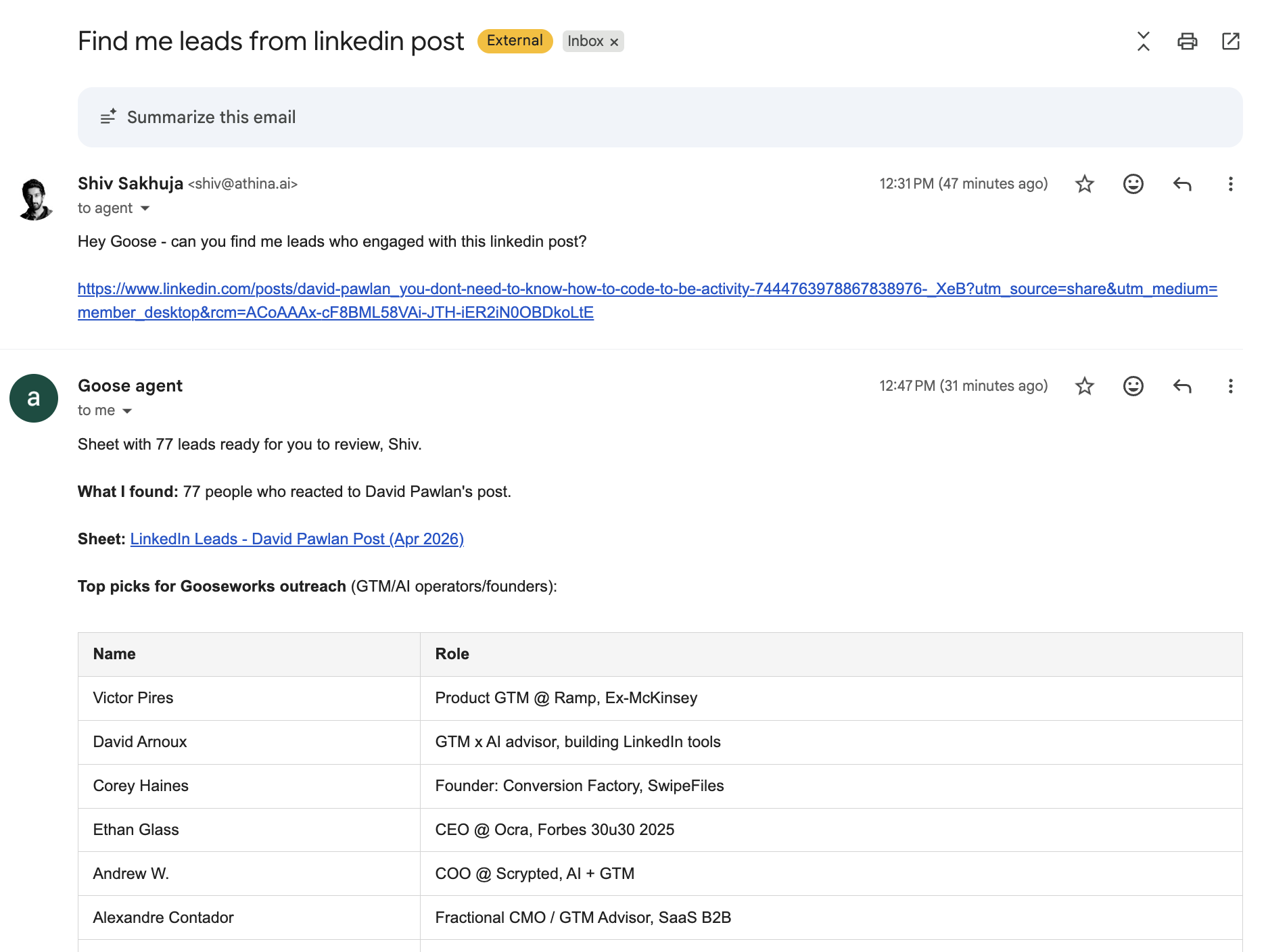
1. People Who Commented on a Competitor's LinkedIn Post
Why this works: Anyone engaging with your competitor's content is already in the market. They're aware of the space, interested enough to interact, and potentially evaluating options — including yours. This is one of the warmest signals you can find.
Best for: Companies with established competitors who post on LinkedIn. Particularly powerful if a competitor just announced a new product, pricing change, or feature — the comment section will be full of active buyers and frustrated customers.
The prompt:
Find everyone who commented on this LinkedIn post: [paste URL] Get me their names, titles, companies, and LinkedIn URLs as a CSV
Send to: agent@gooseworks.sh
2. People Who Starred a GitHub Repo in Your Space
Why this works: A GitHub star is a buying signal in disguise. It means someone found the repo, thought it was relevant to their work, and bookmarked it for later. For developer tools, infrastructure products, and anything technical, repo stargazers are among the most qualified leads you'll find.
Best for: Developer-focused products, open source tools, data infrastructure, AI/ML tooling. Also works for studying your own repo's audience.
The prompt:
Find everyone who starred this GitHub repo: [paste repo URL] Get me their names, companies, job titles, and any contact info available as a CSV
Send to: agent@gooseworks.sh
3. People Speaking at Industry Conferences This Quarter
Why this works: Conference speakers are almost always senior, credible, and well-networked in their field. They have authority to make or influence buying decisions. And they're actively putting themselves out there as thought leaders — which means cold outreach lands very differently than it does with someone who keeps a low profile.
Best for: Enterprise sales, high-ACV products, partnerships, and anyone selling to practitioners rather than just buyers.
The prompt:
Find people speaking at [industry] conferences and events this quarter. Get me their names, companies, job titles, LinkedIn URLs, and the event they're speaking at. Create a CSV
Replace [industry] with your niche — "growth marketing," "AI/ML," "revenue operations," "cybersecurity," etc.
Send to: agent@gooseworks.sh
4. People Who Left 3-Star Reviews of Your Competitors on G2
Why this works: A 1-star review is a rant. A 5-star review is loyalty. A 3-star review is a buyer who is actively frustrated but hasn't left yet — meaning they're in evaluation mode. They know the problem, they've tried a solution, and they're not satisfied. You couldn't manufacture a warmer lead if you tried.
Best for: Any space with established players on G2 or Capterra. Works especially well in SaaS categories with known switching costs — the frustration has to get high enough to matter.
The prompt:
Find people who left 3-star reviews for [competitor name] on G2. Get me their names, titles, companies, and the key pain points they mentioned. Return as a CSV
Send to: agent@gooseworks.sh
5. Companies That Raised a Round in Your Space in the Last 60 Days
Why this works: Fresh capital equals fresh budgets and new buying decisions. A company that raised 6 weeks ago is actively hiring, building, and spending. They haven't locked in their vendor stack yet. The window of new buyer activity after a fundraise is real and finite — this is when you want to be in front of them.
Best for: B2B SaaS, tools, services, and anyone selling into growth-stage companies. Especially effective if your product helps teams scale — you're catching them right as they're about to scale.
The prompt:
Find companies that raised a seed or Series A round in the last 60 days in the [your space] space. Get me the company name, funding amount, founding team names, LinkedIn URLs, and any contact info. Create a CSV
Send to: agent@gooseworks.sh
6. People Who Recently Started a New Job in a Role Your Product Serves
Why this works: New hires are uniquely motivated. They want to prove themselves quickly, they're not yet locked into legacy vendor relationships, and they often have a mandate to "modernize" or "improve" the function they just joined. They move fast and they have budget authority.
Best for: Products that target specific roles (RevOps, GTM Engineer, Head of Growth, CTO, etc.). Works across company sizes but is most powerful at growth-stage companies where new hires have real authority.
The prompt:
Find people who started a new [job title] role in the last 30-60 days at [company type or industry] companies. Get me their names, companies, LinkedIn URLs, and start dates. Create a CSV
Examples:
"Head of Revenue Operations in the last 30 days at Series A-B SaaS companies"
"GTM Engineer in the last 60 days at AI startups"
"VP of Growth in the last 45 days at B2B software companies"
Send to: agent@gooseworks.sh
How This Works
Goose is an AI agent with its own email address. It has hundreds of skills, scrapers, and API connections built in. When you send it a task, it figures out how to execute it, does the work, and sends you back the results — usually as a clean spreadsheet.
You don't need an account. You don't need to pay. You don't need to configure anything.
You just email it a task and wait.
The prompts above are starting points. You can get more specific: add qualifiers, narrow the geography, filter by company size, request specific data fields. Goose will adapt.
The fastest way to find out what it can do is to send it something right now.